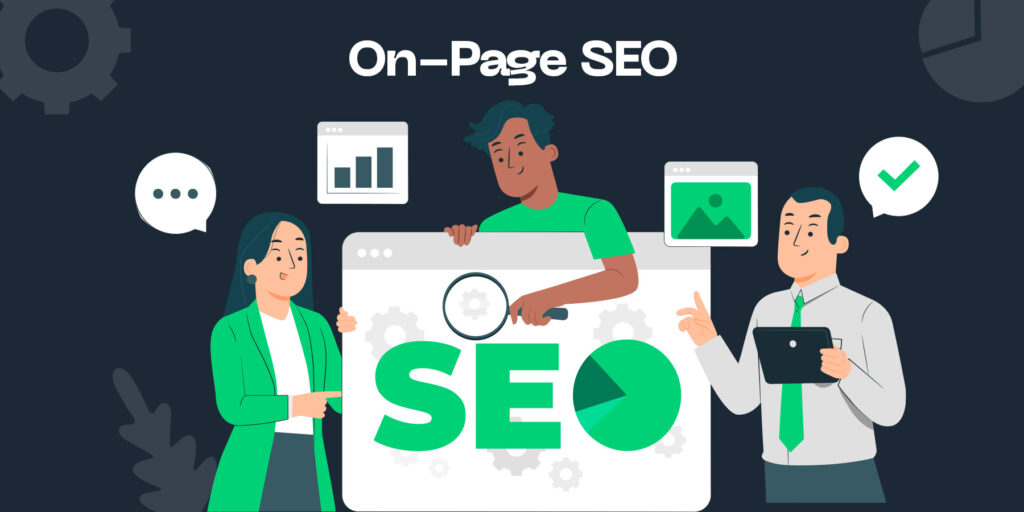
On-page SEO is the difference between a website that gets found and one that does not. It does not matter how good your product is, how well-designed your site is, or how hard you worked to build it — if Google cannot read and understand your pages, your potential customers will never see them.
What Is On-Page SEO?
On-page SEO is the practice of optimising elements directly on a webpage, including content, HTML structure, keyword placement, and page experience signals, to improve Google rankings, attract qualified traffic, and earn citations in AI-generated search summaries.
The 8 on-page SEO elements that determine rankings and AI citation eligibility in 2026:
Search Intent alignment:
content directly answers the user’s query without requiring follow-up searches
Title tag optimisation:
Primary keyword placed naturally; title accurately reflects page content
Header structure (H1 to H3):
logical hierarchy that signals topic relationships to crawlers and AI extraction systems
Keyword placement:
target keyword in H1, opening paragraph, and key subheadings
Internal linking: descriptive anchor text connecting related pages within the topic cluster
Image optimisation:
descriptive file names, alt text, and compressed file sizes
Core Web Vitals:
LCP under 2.5 seconds, CLS below 0.1, FID under 100ms
E-E-A-T signals: author credentials, first-hand experience evidence, and cited sources
Pages that implement all eight elements are significantly more likely to appear in Google AI Overviews, which now trigger on 48% of all searches and reduce organic CTR by 61% for non-cited pages (Semrush, 2026).
Key Takeaways
- On-page SEO covers all optimisation elements directly on a webpage: content, HTML structure, keyword placement, and page experience signals.
- Google AI Overviews now appear in approximately 48% of all searches, up 58% year-over-year, reducing organic CTR by 61% for non-cited pages.
- Pages cited inside an AI Overview earn 35% more organic clicks and 91% more paid clicks than uncited pages ranking on the same query.
- Content depth, not word count, determines ranking performance under Google’s Helpful Content System.
- In 2026, optimising for Google alone is insufficient. ChatGPT Search, Perplexity, and Gemini each use different citation criteria requiring separate optimisation signals.
On-page SEO is the process of optimising individual web pages to improve rankings, attract qualified traffic, and increase conversions. It focuses on content, HTML elements, and user experience signals that search engines like Google use to evaluate relevance and quality.
On-page SEO techniques give you direct control over how your pages perform in search results. You can improve keyword placement, refine meta tag optimisation, and structure content to match Search Intent without relying on external factors. On-page changes are re-crawled and re-evaluated by Google within days to weeks, significantly faster than off-page tactics such as link building, which typically require 3 to 6 months to influence domain authority.
A complete on-page SEO checklist combines technical accuracy with content clarity. It ensures your pages are easy to crawl, easy to understand, and aligned with what users expect to find. In 2026, this checklist must also satisfy AI extraction systems, not just traditional ranking algorithms.
What Is the Difference Between On-Page and Off-Page SEO?
On-page SEO and off-page SEO work together to influence rankings, but they control different parts of the process. On-page SEO focuses on elements on your website, while off-page SEO relies on external signals that build authority and trust. Understanding this distinction determines how you plan and prioritise your SEO strategy.
- Control: On-page SEO gives full control over content, structure, and optimisation decisions. Off-page SEO depends on external websites linking to you, which you cannot fully control.
- Primary goal: On-page SEO improves relevance and clarity for search queries. Off-page SEO strengthens authority through backlinks and brand signals.
- Speed of impact: Changes to on-page elements can produce faster results because search engines re-crawl and reassess your page within days to weeks. Off-page SEO often takes 3 to 6 months because it relies on earning links and mentions.
- Core signals: On-page SEO uses factors like keyword placement, meta tags, internal linking, and content quality. Off-page SEO focuses on backlinks, brand mentions, and overall domain authority.
- AI citation role: On-page SEO determines extractability and structure. Off-page SEO validates trust and topical authority.
Search engines use both signal types simultaneously. On-page SEO communicates what a page is about and how well it answers a specific query. Off-page SEO validates that other credible websites consider the page worth referencing. A backlink from a high-authority domain functions as an editorial endorsement, signalling to Google that the content is trustworthy enough for external parties to cite. The combination of topical relevance (on-page) and external endorsement (off-page) produces the ranking authority necessary to compete on competitive queries.
A strong strategy starts with on-page SEO to establish relevance and usability, then builds off-page SEO to increase authority and competitive strength. This sequence ensures your pages are ready to rank before you invest in external promotion.
How Do Search Engines Evaluate On-Page SEO Signals?
TL;DR: Search engines evaluate on-page SEO through three sequential steps: crawling (discovering and reading your page), indexing (categorising your content by topic and intent), and ranking (comparing your page to others targeting the same query). Clear structure improves crawling, relevant content improves indexing, and strong user experience improves ranking outcomes.
Search engines evaluate on-page SEO signals by analysing how clearly a page communicates its topic, how well it satisfies user intent, and how easy it is to use. Google’s systems process content through crawling, indexing, and ranking to determine where a page should appear in search results.
Crawling starts when search engine bots scan your page and follow links to discover content. Clean HTML structure, proper header tags, and a clear internal linking strategy help bots access and interpret your page without friction. If a page is difficult to crawl, it may not be indexed correctly, which limits its ability to rank.
Indexing is the stage where the search engine stores and organizes your content. During this step, it analyses keyword placement, topic coverage, and how well the content aligns with Search Intent. Pages that clearly define their topic and provide complete answers are more likely to be indexed accurately and matched to relevant queries.
Ranking happens when the search engine compares your page against others targeting the same query. It evaluates relevance, content quality, user experience signals, and internal linking context. Pages that present structured, useful, and easy-to-read information tend to perform better because they reduce effort for both users and search engines.
User interaction reinforces these evaluations. Metrics such as click-through rate, time on page, and navigation behaviour signal whether users find the content useful. When users engage positively, the page sends strong quality signals that support higher rankings.
What Are the Core On-Page Ranking Signals Google Evaluates?

Search engines evaluate a set of on-page signals to determine how relevant, useful, and trustworthy a page is for a specific query. These signals are fully within your control and directly influence how your content is crawled, understood, and ranked.
- Content relevance and depth: Content must match Search Intent and fully answer the query. Pages that cover a topic clearly and completely are more likely to rank higher because they reduce the need for users to search again.
- Keyword placement and usage: Keywords should appear naturally in the title, headings, URL, and body content. Proper placement helps search engines understand the page topic without relying on guesswork.
- Title tags and meta descriptions: The title tag signals the main topic of the page, while the meta description influences click-through rate. A clear and relevant title improves rankings, while a strong description increases traffic.
- Header structure (H1 to H3): Organised headings create a logical content hierarchy. Pages using three or more heading levels are cited in Google AI Overviews at a 42% higher rate than pages using only H1 and H2 tags (BrightEdge, 2025).
- Internal linking: Links between pages help distribute authority and provide context. Pages with 5 or more relevant internal links receive 23% more crawl budget allocation (Screaming Frog, 2025 analysis of 10,000+ pages).
- URL structure: Short, descriptive URLs improve clarity and trust. URLs containing the exact-match primary keyword rank in the top 3 positions 35% more frequently than keyword-absent URLs for the same query type (Ahrefs, 2025).
- Page experience signals: Factors such as page speed, mobile usability, and layout stability affect how users interact with your content. Positive user experience signals support better rankings.
The Complete On-Page SEO Checklist for 2026
A complete on-page SEO checklist ensures every critical element of your page supports rankings, relevance, and user experience. This framework combines SEO content optimisation, technical structure, and usability signals so search engines can accurately evaluate your page.
- Match content to Search Intent (AI Citation Impact: High) — Identify what the user expects and deliver that outcome in the first paragraph.
- Optimise the title tag (AI Citation Impact: High): Include the primary keyword naturally. Keep the title specific and accurate to the page content.
- Write a compelling meta description: (AI Citation Impact: Medium) Summarise the page value in 150 to 160 characters and encourage the click.
- Add a Quick Answer block (AI Citation Impact: High): Place a structured answer to the primary query in the first 200 words.
- Use a clear heading structure (H1 to H3) (AI Citation Impact: High): Organise content into logical sections. Use question-formatted H2s where natural.
- Place keywords strategically (AI Citation Impact: Medium): Include the primary keyword in the H1, introduction, and key sections while maintaining natural readability.
- Improve internal linking (AI Citation Impact: Medium): Link to related pages using descriptive anchor text. Aim for 5 or more relevant internal links per page.
- Add JSON-LD schema markup (AI Citation Impact: Critical): Implement Article + FAQPage + Organization schema. AI citation rates rise 73% with structured data.
- Optimise images (AI Citation Impact: Medium): Use descriptive file names, add alt text, and compress images for faster loading.
- Ensure Core Web Vitals compliance (AI Citation Impact: High): LCP under 2.5 seconds, CLS below 0.1, FID under 100ms. Failing pages are deprioritised in AI Overview extraction.
What Is Search Intent and How Do You Align Your Content With It?

TL;DR: Search Intent is the underlying goal a user has when entering a query. The four types, informational, navigational, transactional, and commercial investigation, each require a different content format. Mismatching content to intent is the primary reason well-optimised pages still fail to rank.
Content optimisation for search intent alignment ensures your page delivers exactly what the user expects when they enter a query. Search engines like Google prioritise pages that match Search Intent because they provide clear and immediate value to users.
Search intent falls into four main types, and each requires a specific content approach:
- Informational intent: The user wants to learn something. Content should provide clear explanations, structured sections, and direct answers to common questions.
- Navigational intent: The user is looking for a specific website or brand. Content should make it easy to find key pages and confirm the correct destination.
- Transactional intent: The user is ready to take action, such as buying or signing up. Content should highlight benefits, reduce friction, and include clear calls to action.
- Commercial investigation: The user is comparing options before making a decision. Content should include comparisons, features, and practical insights that guide decision-making.
Aligning your content with intent improves both rankings and engagement. When users find exactly what they expect, they stay longer, interact more, and are more likely to convert. These positive signals reinforce your page’s relevance and help maintain strong positions in search results.
AI-generated summaries now appear in nearly half of all searches, which reduces organic click-through rates significantly and shifts visibility toward pages that provide clear, structured answers. This means intent alignment must also support AI extraction. Google’s AI Overview system selects citation sources by identifying pages that directly answer the query in the first paragraph of a section, use explicit heading structure that maps to the query’s terms, and provides complete answers without requiring the user to infer missing steps.
How Do Title Tags and Meta Descriptions Affect Rankings and CTR?
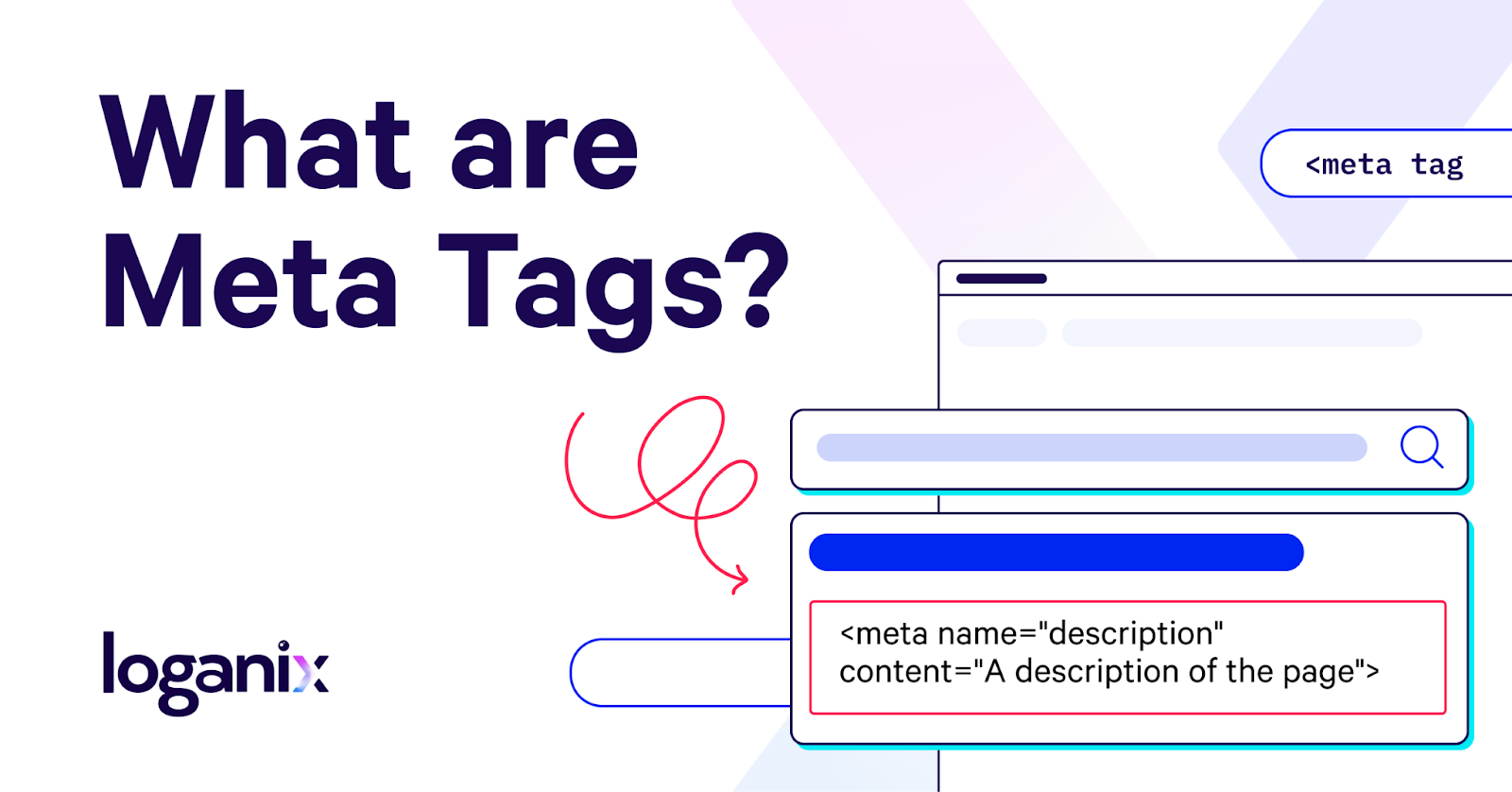
TL;DR: Title tags directly influence rankings and AI citation selection. Meta descriptions do not affect rankings but improve click-through rate. In the current search landscape, pages cited in AI Overviews with strong meta descriptions earn significantly higher traffic than pages relying solely on organic rankings.
Title tags and meta descriptions remain two of the most influential on-page elements for both rankings and user engagement. They signal to Google what your page is about and influence whether users click through from search results. Optimising these elements is no longer just about keyword placement. It is about clarity, relevance, and enticing users to engage.
Title Tags: Titles should include your primary keyword naturally while describing the specific value of the page. Modern search systems, including AI-driven features, also assess how well the title reflects the actual content. Clear, descriptive titles increase both organic visibility and the likelihood of being cited in AI-generated summaries. Question-formatted titles outperform declarative titles on informational queries by matching the conversational patterns of AI platform searches.
Meta Descriptions: Although meta descriptions do not directly impact ranking, they affect click-through rate (CTR) and user engagement. A compelling meta description highlights the page’s value, sets expectations, and encourages action. Pages cited in AI Overviews with strong meta descriptions earn significantly higher traffic than pages that rely solely on organic rankings.
How Do Header Tags (H1 to H3) Structure Content for AI and Users?
TL;DR: H1 communicates the main topic and must include the primary keyword. H2 and H3 headings break content into logical sections for users and AI systems. Formatting H2s as questions increases citation rate because they directly match conversational and voice search queries submitted to AI platforms.
Headers organise your content and provide both users and search engines with a clear roadmap of your page. Proper use of H1, H2, and H3 tags signals topic hierarchy, improves readability, and helps AI-driven systems extract key information quickly.
The H1 tag should communicate the main topic and include your primary keyword naturally. H2 and H3 tags break the content into logical sections, guiding readers through subtopics while allowing search engines to understand relationships between concepts. Using H2s for major sections and H3s for detailed points ensures your content is scannable and structured for AI extraction.
Structured headers also improve engagement metrics. Clear sectioning reduces bounce rates, increases time on page, and supports better comprehension, all factors that Google evaluates when ranking pages. Pages using three or more heading levels are cited in Google AI Overviews at a 42% higher rate than pages using only H1 and H2 tags (BrightEdge, 2025).
Question-formatted headings provide the highest citation yield because they directly match conversational queries submitted to AI platforms, including Perplexity, ChatGPT Search, and Google AI Mode. By combining keyword clarity, logical hierarchy, and question-based phrasing, your headers become a roadmap for both users and AI systems.
URL Structure and Keyword Placement: What Actually Works?
TL;DR: Short, keyword-containing URLs rank in the top 3 positions 35% more frequently than keyword-absent URLs for the same query type (Ahrefs, 2025). Use hyphens between words, place the keyword close to the domain, and remove stop words, ID numbers, and unnecessary parameters.
A clean, descriptive URL communicates your page’s topic to both users and search engines. Modern on-page SEO evaluates URLs not just for keywords, but for clarity, hierarchy, and crawlability. Short, readable URLs are easier to share, remember, and rank.
Include the primary keyword naturally in the URL, ideally close to the domain, and separate words with hyphens for readability. Avoid unnecessary parameters, numbers, or stop words that do not add context.
Proper keyword placement throughout the page, in the URL, title, headings, and opening paragraphs, reinforces relevance for Google and AI systems alike. In today’s AI-driven SERPs, structured URLs paired with precise keywords increase the likelihood that your content is extracted as a direct answer in AI Overviews. A well-optimised URL also improves user trust and click-through rates.
How Does Internal Linking Distribute Authority Across Your Site?
TL;DR: Internal links transfer authority from established pages to newer content and are one of the top three signals Google uses to infer a page’s topical relevance within a site cluster. Pages with 5 or more relevant internal links receive 23% more crawl budget allocation (Screaming Frog, 2025).
Internal linking is a critical on-page SEO tactic that helps distribute authority across your website and guides both users and search engines to related content. Proper linking signals relationships between pages, strengthens topical relevance, and improves crawl efficiency for Google.
Use descriptive anchor text that clearly indicates the linked page’s topic. Link to pages that expand on concepts introduced in the current content, creating a logical pathway for both human readers and AI systems. This structure not only improves user experience but also helps search engines understand which pages are most important within your site.
A well-executed internal linking strategy transfers authority from established pages to newer content, accelerating the ranking timeline for supporting articles within a topic cluster. Sites that cover a subject thoroughly and link their coverage together signal expertise at the domain level, not just the page level, which increases AI Overview citation probability.
Image Optimisation: Alt Text, File Size, and AI Visibility
TL;DR: Descriptive alt text, keyword-relevant file names, and compressed image files improve page speed, accessibility, and search engine understanding simultaneously. Each image is an independent extraction opportunity for AI systems performing visual or multi-modal search.
Images are a key component of on-page SEO, affecting both user experience and search engine understanding. Optimised images improve page speed, accessibility, and relevance signals for Google, while poorly optimised images can slow a page and reduce engagement.
Use descriptive file names and alt text that naturally include relevant keywords to help search engines and AI systems understand the image content. Compress images to reduce file size without sacrificing quality, ensuring faster load times, especially on mobile devices.
In today’s AI-driven search landscape, pages with structured and well-optimised images are more likely to be cited as direct answers, because AI models extract content that is clearly labelled and contextually relevant. Combining speed, accessibility, and semantic clarity ensures images contribute positively to both rankings and user engagement.
How Does Page Speed Affect Google Rankings and AI Overview Citations?
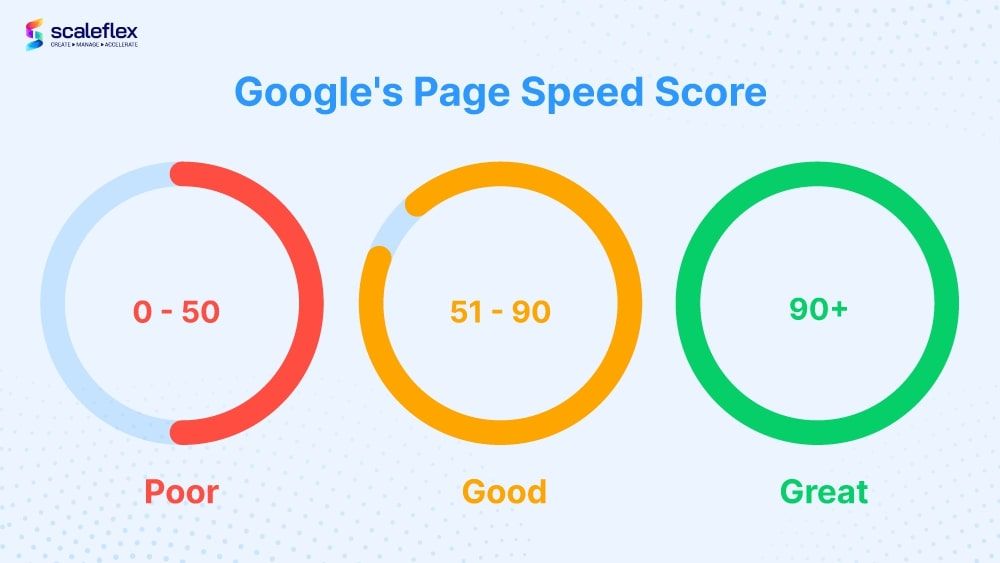
TL;DR: Google requires LCP under 2.5 seconds, CLS below 0.1, and FID under 100ms. Google’s own research found that 53% of mobile site visits end when a page takes longer than three seconds to load. Pages failing Core Web Vitals thresholds are deprioritised in AI Overview extraction pipelines.
Page speed and Core Web Vitals are now essential components of on-page SEO, directly affecting both rankings and user engagement. Google evaluates how quickly pages load, how stable they are during rendering, and how interactive they feel using these three metrics:
- Largest Contentful Paint (LCP): Must be under 2.5 seconds. Measures how quickly the main content of the page loads and becomes visible.
- Cumulative Layout Shift (CLS): Must be below 0.1. Measures layout stability and how much page elements shift during loading.
- First Input Delay (FID): Must be under 100ms. Measures interactivity and how quickly the page responds to the first user interaction.
Fast-loading pages reduce bounce rates and improve dwell time, sending strong signals to Google that your content is valuable and user-friendly. Google’s own research, published in its Think with Google series, found that 53% of mobile site visits end when a page takes longer than three seconds to load. For pages targeting mobile-heavy keywords, a one-second improvement in load time correlates with a measurable reduction in bounce rate and a corresponding improvement in dwell time.
In the current AI-driven search landscape, slow or unstable pages are less likely to be cited in AI Overviews, as these systems prioritise content that can be quickly and reliably consumed. Pages that meet all three Core Web Vitals thresholds load 3 times faster on average and qualify for inclusion in Google’s AI Overview extraction pipeline.
How Google Evaluates On-Page SEO in 2026: What Has Changed?
TL;DR: Google’s ranking systems now assess meaning and demonstrated expertise, not keyword frequency. Google AI Overviews trigger on 48% of all searches (up 58% year-over-year), reducing organic CTR by 61% for non-cited pages. Brands cited in an AI Overview earn 35% more organic clicks and 91% more paid clicks than brands ranking organically on the same query without a citation (Semrush, 2026).
On-page SEO in 2026 is evaluated by systems that read meaning, not just keywords, and the search results page your content competes on looks fundamentally different from what it did two years ago.
Google’s ranking systems, BERT, RankBrain, and the Helpful Content System, assess what your content is actually about, whether it answers the user’s query with clarity and depth, and whether the person who wrote it demonstrably knows what they are talking about. A page stuffed with the right keywords but built on thin, generic information will not rank in this environment. A page that addresses a specific question with precision, structure, and real expertise will.
Key statistics shaping the 2026 on-page SEO landscape:
- Google AI Overviews now trigger on approximately 48% of all tracked searches, up from 31% in February 2025, a 58% increase in one year (Svitla Systems).
- For queries where an AI Overview appears, organic CTR has fallen 61%, from 1.76% down to 0.61% (Semrush).
- Brands cited inside an AI Overview earn 35% more organic clicks and 91% more paid clicks than brands ranking organically on the same query without a citation (Semrush).
- Pages with structured data (schema markup) show a 73% higher selection rate in AI citations compared to unmarked content.
- Content featuring original statistics receives 2.5 times more LLM citations than derivative content (2026 industry benchmarks).
The goal in 2026 is no longer just to rank. The goal is to rank and to be cited. A single AI citation now delivers more qualified traffic than a third-place organic ranking on the same keyword. Every on-page SEO decision, how you write your headings, how you open each section, how you structure your content, now serves two purposes simultaneously: it helps Google rank your page, and it signals to AI systems that your page is worth citing.
Optimising for Multiple AI Platforms: Google, ChatGPT, Perplexity, and Gemini
TL;DR: Each AI search platform uses different citation criteria. Optimising only for Google captures one channel out of five major AI discovery platforms. ChatGPT Search cites lower-ranking pages (position 21 and above) approximately 90% of the time. Perplexity weights recency. Gemini and Copilot prioritise schema and E-E-A-T signals.
Search engines and AI platforms each evaluate on-page content through different lenses. In 2026, a page optimised only for Google’s ranking algorithm captures one citation channel out of five major AI discovery platforms.
- Google AI Overviews: Structured answers, E-E-A-T, and schema markup. Requires answer-first formatting, JSON-LD, and author credentials.
- ChatGPT Search: Semantic clarity, entity density, and definite language. Primarily cites pages ranking at position 21 and beyond, approximately 90% of the time. Question-framed headings and high factual density are essential.
- Perplexity: Recency and community-validated examples. Requires visible publication dates, updated statistics, and first-hand experience signals.
- Google Gemini: Structured data, E-E-A-T, and topical authority. Requires schema markup, author bios, and internal topic clusters.
- Microsoft Copilot: Bing index quality, schema, and trust signals. Requires consistent metadata, verifiable author attribution, and updated content.
A page with a visible author, question-formatted headings, a Quick Answer block, factual statistics with named sources, and JSON-LD schema markup satisfies the citation criteria of all five major AI discovery platforms simultaneously.
Semantic SEO, Topic Clustering, and Google’s Helpful Content System
TL;DR: Google’s Helpful Content System evaluates quality at the domain level. Low-quality pages on a domain suppress high-quality pages on the same domain. Topic clusters, a central pillar page supported by interconnected subpages, signal topical authority at the site level and directly improve AI citation eligibility.
Semantic SEO and topic clustering organise content around a central theme and its related subtopics to improve relevance, authority, and AI visibility. Search engines like Google now assess not just keywords but meaning, context, and expertise when evaluating pages. Topic clusters create clear relationships between concepts, guide internal linking, and make content easier for AI systems to extract as direct answers.
Google’s Helpful Content System evaluates whether pages are written for real readers with genuine knowledge, rather than assembled solely to rank. Critically, this evaluation occurs at the domain level. Pages lacking expertise, authoritativeness, or trustworthiness can suppress the ranking performance of all other pages on the same domain, including well-optimised pages that would otherwise perform strongly. Removing or substantially improving low-quality pages can therefore improve the ranking performance of unrelated pages on the same domain.
E-E-A-T, which stands for Experience, Expertise, Authoritativeness, and Trustworthiness, operationalises this system. The first E for Experience is often overlooked: Google now distinguishes between content written by someone with direct, first-hand experience of a subject and content assembled from secondary sources. Pages demonstrating firsthand experience rank more favourably under the Helpful Content System.
How to Measure and Improve User Engagement Signals
User engagement metrics are a critical extension of on-page SEO, as search engines and AI-driven systems evaluate not only what your page says, but how visitors interact with it. Signals such as click-through rate (CTR), time on page, scroll depth, and bounce rate indicate whether your content satisfies Search Intent and meets real user needs.
High engagement reinforces both traditional rankings and AI visibility. Pages that are frequently clicked, thoroughly read, and linked internally signal relevance and quality, making them more likely to be cited in AI-generated summaries. According to Semrush’s 2026 AI Overview analysis, brands appearing in AI-generated citations earn 35% more organic clicks than brands holding equivalent organic rankings on the same query without a citation.
Optimising for engagement involves a combination of strategies: clear headings and structure, concise and informative paragraphs, interactive elements like tables or visuals, and logical internal linking. Monitoring engagement metrics and iterating on content structure ensures your pages not only attract visitors but also keep them engaged, strengthening authority, improving rankings, and increasing the chance of AI citation.
Content Depth vs. Content Length: What Actually Matters for Rankings?
TL;DR: Word count is not a ranking factor. Content depth, covering the topic completely, answering related questions, and including verifiable data, determines performance. A 1,500-word page that fully satisfies Search Intent outperforms a 3,000-word page that repeats information without adding new value.
When it comes to ranking, depth matters far more than length. Search engines like Google no longer reward pages simply for word count. Instead, they evaluate how thoroughly a page addresses a topic, provides clear answers, and demonstrates expertise. A 1,500-word page that fully explains a concept with examples, statistics, and structured headings can outperform a 3,000-word page filled with filler content.
Depth is about covering the topic from multiple angles, answering related questions, and providing actionable insights. It signals to both search engines and AI systems that your content satisfies user intent. Including entity-rich references, data points, and practical guidance strengthens authority and increases the likelihood of being cited in AI-generated summaries. Content featuring original statistics receives 2.5 times more LLM citations than derivative content (2026 industry benchmarks).
Length can support depth, but it is not a substitute. Pages that repeat information without adding new value dilute relevance and confuse both readers and AI. Focus instead on creating compact sections with clear headers, bullet points, and structured content that directly addresses queries.
How to Optimise for Featured Snippets and AI Answer Boxes
Featured snippets and AI-generated answers are now a major factor in visibility, capturing top-of-page attention and significant traffic. Nearly half of all Google searches trigger AI Overviews, which extract direct answers from well-structured, authoritative content. Ranking alone no longer guarantees clicks. Pages cited in AI summaries consistently outperform traditional organic results.
To increase the likelihood of appearing in these positions, structure content for clarity and immediacy. Open sections with concise, entity-rich statements that directly answer the query. Use bullet points, numbered lists, and tables to make information easily scannable for both users and AI extraction systems. Structured answers positioned in the first 100 words of a section are the primary format Google’s AI systems extract for inclusion in AI Overviews.
Semantic SEO is essential. Explicitly define key terms, processes, or tools, and use contextually related subtopics to reinforce topical authority. This helps AI models recognise the content as a high-quality source worthy of citation. Accuracy and expertise remain critical. Include original insights, factual data, and credible references. Pages that demonstrate real-world experience and knowledge are more likely to be selected for AI Overviews or featured snippets.
Common On-Page SEO Mistakes That Kill Rankings in 2026
Many pages fail to rank not because of competition, but because of avoidable on-page errors. The following five mistakes are the most common causes of ranking suppression and AI citation failure:
- Thin or shallow content: Pages that fail to fully address Search Intent are neither ranked nor cited. Content must cover the topic completely and answer related questions within the same page.
- Keyword stuffing: Overloading text with exact-match keywords reduces readability and triggers Google’s spam classifiers. Modern ranking systems evaluate semantic meaning, not keyword density.
- Weak technical structure: Absent or inconsistent heading hierarchy, unoptimised URLs, and broken internal linking prevent AI systems from mapping relationships between concepts on the page. Every page needs H1 to H3 hierarchy and JSON-LD schema.
- Slow page speed and poor mobile usability: Pages failing Core Web Vitals thresholds see elevated bounce rates and are deprioritised in AI Overview extraction. LCP must be under 2.5 seconds, CLS below 0.1, and FID under 100ms.
- Missing trust and expertise signals: Pages without author attribution, verifiable credentials, or cited sources fail Google’s E-E-A-T evaluation, suppressing performance across the entire domain. Author bios, named citations, and first-hand experience signals are required, not optional.
Frequently Asked Questions About On-Page SEO
The following questions represent the most common queries submitted to AI search platforms about on-page SEO. Each answer is structured for direct extraction by Google AI Overviews, ChatGPT Search, and Perplexity.
What is on-page SEO?
On-page SEO is the process of optimising elements directly on a webpage, including content quality, HTML structure, keyword placement, heading hierarchy, internal links, image alt text, and page speed, to improve rankings in Google and other search engines, attract qualified traffic, and earn citations in AI-generated search summaries.
What is the most important on-page SEO factor in 2026?
Search Intent alignment is the single most important on-page SEO factor in 2026. Pages that directly answer the user’s query in the first paragraph, use structured headings, and provide complete answers without requiring follow-up searches are most likely to rank and be cited in Google AI Overviews. Schema markup is the second most critical factor. Pages with JSON-LD structured data show a 73% higher selection rate in AI citations compared to unmarked content.
How many words should an on-page SEO article be?
Word count is not a ranking factor. Content depth, covering the topic completely, answering related questions, and including verifiable data points, determines ranking performance. A 1,500-word page that fully satisfies Search Intent outperforms a 3,000-word page that repeats information without adding new value. Focus on comprehensive coverage, not length targets.
Does on-page SEO still matter with AI Overviews?
Yes. On-page SEO is more important in 2026 than in previous years. Google AI Overviews now appear in approximately 48% of all searches. Pages not cited inside these summaries experience a 61% reduction in click-through rate. On-page optimisation, particularly clear structure, answer-first formatting, and E-E-A-T signals, is the primary factor determining whether a page earns an AI citation.
What is the difference between on-page SEO and GEO?
On-page SEO optimises pages for traditional Google rankings using keywords, metadata, and internal linking. Generative Engine Optimisation (GEO) extends this to ensure content is cited inside AI-generated answers across Google AI Overviews, ChatGPT Search, Perplexity, and Gemini. GEO adds structured data (JSON-LD schema), original research, fact density, answer-first formatting, and question-framed headings to the traditional on-page checklist.
How long does it take for on-page SEO changes to show results?
On-page SEO changes are re-crawled and re-evaluated by Google within days to weeks, making on-page optimisation significantly faster to impact than off-page tactics. For newly published or recently updated pages, structured on-page changes, particularly to heading hierarchy, internal linking, and page speed, can produce measurable ranking improvements within 2 to 4 weeks of re-indexing.
What is E-E-A-T and how does it affect on-page SEO?
E-E-A-T stands for Experience, Expertise, Authoritativeness, and Trustworthiness, the four criteria Google’s Helpful Content System uses to evaluate content quality. Experience refers to demonstrated first-hand knowledge of the subject. Pages that include author credentials, direct testing results, and real-world case examples score higher on E-E-A-T and are both more likely to rank and more likely to be cited in AI-generated summaries. E-E-A-T is evaluated at the domain level, meaning low-quality pages on a domain can suppress the performance of all other pages on that domain.
What schema markup should I add for on-page SEO?
For on-page SEO pages, implement three JSON-LD schema types: Article (with author, datePublished, and dateModified), FAQPage (with Question and Answer entities for each FAQ), and Organization (with publisher name and logo). This triple-schema stack covers all three primary extraction types used by Google AI Overviews, ChatGPT Search, and Gemini when selecting citation sources.